Best ADCC Takedowns for BJJ Athletes Who Are Not Wrestlers
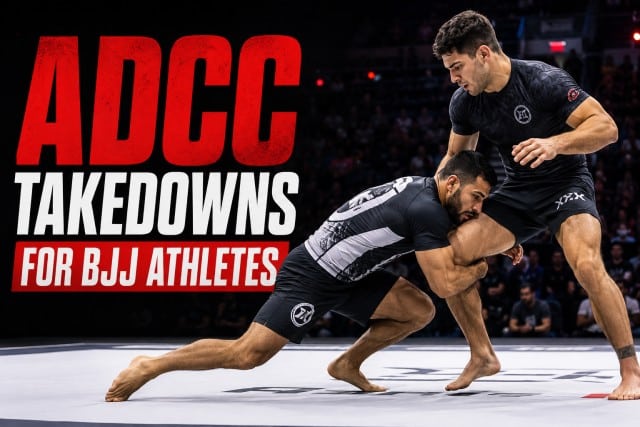
For many BJJ athletes, ADCC-style competition creates one immediate problem: the standing phase feels uncomfortable, rushed, and expensive. You do not need to become a former college wrestler overnight to fix that. What you do need is a small set of takedowns and standing attacks that match how jiu-jitsu athletes actually move, grip, and think.
This article breaks down the best ADCC takedowns for BJJ athletes who are not wrestlers. The focus here is not on flashy amplitude or deep wrestling chains. It is on reliable entries that fit no-gi grappling, protect you from bad scrambles, and connect naturally to front headlocks, guard pulls, body locks, and passing sequences. If you want broader context on the event itself, see our ADCC overview.
What Makes a Good ADCC Takedown for a BJJ Athlete?
A good ADCC takedown for a non-wrestler usually has four qualities:
- It does not require elite penetration-step timing.
- It keeps your head and posture reasonably safe.
- It creates top position or immediate submission threats.
- It connects well to the rest of a jiu-jitsu game.
That matters because most BJJ athletes are not trying to win long hand-fighting exchanges with pure wrestling pressure. They are trying to create an efficient opening, score if possible, and move quickly into the parts of grappling where they are strongest.
1. Snap-Down to Front Headlock
If you only develop one standing attack for ADCC, this is a strong candidate. The snap-down is accessible, low-risk compared with many committed shots, and leads directly to one of the most valuable positions in no-gi grappling: the front headlock.
Why It Works
Many BJJ athletes are more comfortable attacking the neck and upper body than finishing explosive leg attacks. A snap-down lets you turn hand fighting into a controlling, threatening position without needing perfect wrestling mechanics.
Basic Entry
- Start from a collar tie, inside tie, or brief wrist control.
- Move your opponent before you pull. Do not snap a stable stance.
- Pull the head down as you angle off, rather than staying square in front.
- Look to cover the head and an arm, then circle toward dominant control.
Best Use Cases
- Against upright opponents with high posture.
- Against athletes who reach heavily with collar ties.
- As a reaction when your opponent pulls away from your grip.
Common Mistakes
- Trying to yank straight down with only your arms.
- Leaving your hips too close and getting re-shot on.
- Snapping without angling off to a better line.
If you want a resource built around this more scrimmage-style approach to standing exchanges, our review of Systematically Attacking the Scrimmage is a useful next read.
2. Collar Tie to Ankle Pick
The ankle pick is one of the best options for BJJ athletes because it rewards timing, posture, and direction more than raw speed. It also works well from upright hand fighting that already feels familiar to many jiu-jitsu players.
Why It Works
You can threaten the head, force your opponent to step, and attack the leg when their weight becomes light. This makes it a strong choice for athletes who are not confident shooting deeply on doubles.
Key Cues
- Pull the head slightly off line before you reach for the ankle.
- Pick the ankle when the foot is light, not when the leg is heavily planted.
- Drive your opponent into the space where the foot used to be.
- Keep your chest over your lead knee so you do not overreach.
When It Fits ADCC
The ankle pick works especially well in matches where both athletes are cautious about overcommitting. It is efficient, hard to see when timed well, and often leads to clean top position without a big scramble.
Common Mistakes
- Reaching for the ankle before affecting posture.
- Picking from too far away.
- Stopping after touching the ankle instead of driving through the finish.
3. Single Leg from an Outside Angle
The single leg still belongs on this list, but with one important adjustment: most BJJ athletes should think less about blasting through the middle and more about finding the outside angle first.
Why This Version Is Better for Non-Wrestlers
Shooting straight down the center can expose your neck, stall your motion, and leave you under a sprawl. By attacking from an angle, you often meet less resistance and keep better posture through the finish.
Simple Setup Ideas
- Snap, then attack when your opponent rises back up.
- Use wrist control to make them step.
- Fake high, then enter low.
- Circle toward the lead leg instead of chasing it from too far out.
Finishing Advice for BJJ Athletes
- Get your head up early.
- Lock above the knee if possible.
- Come up to your feet rather than staying bent underneath.
- If the finish stalls, transition to running the pipe, a shelf finish, or a rear body lock instead of forcing the first option forever.
This is also where style matters. Athletes with wrestling-heavy games, like Nicky Rodriguez, can often pressure through standing exchanges in ways that pure jiu-jitsu athletes cannot. For most BJJ competitors, the lesson is not to copy the athleticism. It is to copy the clarity of entries and the commitment to posture.
4. Arm Drag to Rear Body Lock
The arm drag is one of the cleanest bridges between jiu-jitsu and wrestling. It suits BJJ athletes because it uses connection, angle, and back exposure rather than a head-on collision.
Why It Works
Many grapplers are already comfortable using drags from seated guard, butterfly guard, and scrambles. Bringing that same idea to standing makes the transition feel natural.
What to Focus On
- Pull the arm across your center line, not just downward.
- Step to the outside immediately.
- Do not admire the drag. Chase the angle.
- Connect your hands around the waist or lock a seatbelt-style control as soon as you get behind.
Best Follow-Ups
- Rear body lock mat return.
- Trip from behind.
- Return to the front headlock if they square up hard.
Common Mistakes
- Dragging with no footwork.
- Staying chest-to-chest after winning the angle.
- Letting go too early and turning a good entry into a scramble.
5. Wrestle-Up from Seated Guard
This is the most BJJ-specific entry on the list, and for many non-wrestlers it may be the most realistic one to build first. Instead of forcing a pure standing exchange, you create a takedown from a guard situation you already understand.
Why It Is So Useful
If your seated guard is decent, the wrestle-up allows you to turn defensive-looking exchanges into offensive ones. It also fits the decision-making style of many ADCC competitors, who move fluidly between standing, seated guard, and leg-attack threats.
Good Triggers for the Wrestle-Up
- Your opponent reaches too far with their hands.
- Your opponent stands tall to avoid leg entanglements.
- You create a reaction with foot-to-hip or shin-to-shin contact.
- You get them stepping backward in a predictable line.
How to Keep It Clean
- Come up with your head tight and your posture organized.
- Do not stay extended on your knees.
- Finish the action quickly into a single leg, body lock, or back take.
For an example of a highly technical no-gi athlete who built elite success without relying on a traditional wrestler’s style, see our profile on Lachlan Giles. His game is a reminder that smart entries and connected systems often matter more than having a classic wrestling background.
A Simple ADCC Takedown Strategy for Non-Wrestlers
If you are unsure where to start, keep the standing game narrow:
- Primary attack: snap-down to front headlock.
- Secondary attack: ankle pick when posture rises.
- Committed leg attack: outside-angle single leg.
- Positional attack: arm drag to rear body lock.
- Guard-based option: wrestle-up from seated guard.
That is already enough to make you dangerous. The mistake many BJJ athletes make is trying to learn too many takedowns at once. A smaller system, trained consistently, usually gives better results than collecting ten techniques you cannot connect under pressure.
How to Train These Without Burning Out
- Start every no-gi round with one minute of hand fighting from standing.
- Pick one main attack for a full week, not one per round.
- Drill the entry, the finish, and the bailout when it fails.
- Add one follow-up attack so your game has a simple chain.
- Review footage or instructionals that match your actual body type and style.
The goal is not to become a wrestler in a month. The goal is to become hard to outscore, hard to pressure, and capable of getting to your best jiu-jitsu without giving away easy openings.
Final Thoughts
The best ADCC takedowns for BJJ athletes who are not wrestlers are usually the ones that feel repeatable under stress. Snap-downs, ankle picks, outside-angle single legs, arm drags, and wrestle-ups all let you play a more jiu-jitsu-friendly standing game while still becoming a real threat on the feet.
If you can build just two or three of these into a connected system, your ADCC-style grappling will improve quickly. You do not need a huge wrestling playbook. You need a few reliable entries, disciplined posture, and enough repetition that the standing phase stops feeling like borrowed time.