How to Train for ADCC Rules in a Regular BJJ Gym
ADCC is not just “normal no-gi with heel hooks.” The ruleset changes how people wrestle, how they pace themselves, how they value top position, and how they take risks from guard. That is why many good gym grapplers feel sharp in regular rounds but look strangely uncomfortable when they try to compete under ADCC rules.
The good news is that you do not need a room full of elite wrestlers or a full-time competition team to prepare properly. You can build a lot of ADCC-specific skill inside a normal academy if you train with the right constraints, the right starting positions, and the right priorities. If you are still building your overall training structure, our guide on how to learn BJJ is a useful starting point.
What Makes ADCC Training Different?
ADCC places more value on initiative than many hobbyists realize. Even before the points period, the match often revolves around who is pushing the action, who is winning the hand fight, and who is forcing the other person to react. Once points begin, wrestling exchanges, guard passing pressure, back exposure, and clean top control become even more important.
That means ADCC training should emphasize:
- starting from standing more often
- strong front-headlock and go-behind awareness
- wrestle-up ability from seated and supine guard
- positional urgency without reckless scrambling
- leg-lock awareness on both offense and defense
- the ability to win top position and stay there
If your normal rounds begin from the knees, reset too quickly, or ignore scoring logic, you are probably leaving a big gap between your gym game and your competition game.
Start More Rounds From Standing
This is the simplest upgrade and probably the most important one. ADCC matches begin with wrestling, and even guard players need to understand the early hand-fighting phase. You do not need to turn your academy into a collegiate wrestling room, but you do need regular exposure to stance, level changes, collar ties, snaps, and basic finishes.
A good baseline is to start several rounds per week from standing with a clear goal: get to a clean takedown, front headlock, body lock, or safe guard pull that immediately connects to offense. For many BJJ athletes, a small set of dependable takedowns is better than chasing a large menu of techniques. That is especially true if you are a jiu-jitsu-first athlete rather than a lifelong wrestler.
If you want a practical model for this, see our look at lower-body takedown systems for BJJ, which fits well with ADCC-style training.
Build a Real Seated Guard and Wrestle-Up Layer
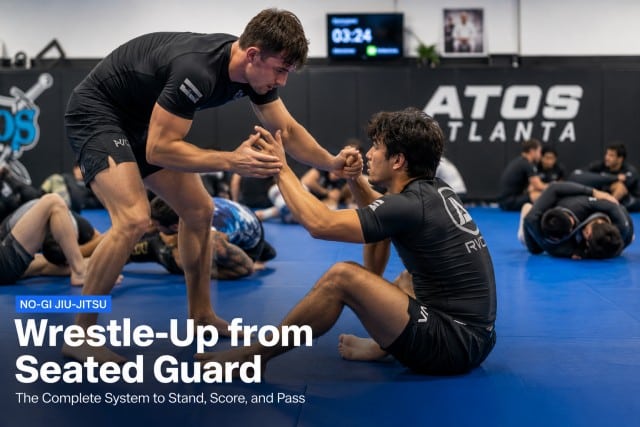
In ADCC, sitting to guard is not automatically a bad decision. The problem is sitting without a plan. If you choose to play guard, you need immediate connection: hands on the opponent, feet in useful places, off-balancing pressure, and a clear route into leg entries, wrestle-ups, or upper-body attacks.
A useful gym rule is this: if you sit, you must attack within a few seconds. No passive scooting. No waiting for the other person to make a mistake. Train yourself to connect your guard to action.
Good first layers include:
- arm drags into rear angles
- single-leg wrestle-ups
- ankle picks off seated reactions
- shin-to-shin entries
- single-leg X or leg-entry transitions when opponents overcommit forward
This does not mean every guard exchange should become a leg-lock shootout. It means your guard should create meaningful dilemmas. If the opponent pressures in, you threaten elevation, off-balancing, or entanglements. If they disengage or posture too high, you come up on the legs.
Train the No-Points Period on Purpose
One common mistake is treating the opening phase like a waiting room. High-level ADCC competitors do the opposite. They use the early period to gather reactions, force scrambles, threaten front headlocks, and create fatigue without giving away easy scores later.
In the gym, try rounds where the first half is “no points, but not no purpose.” Your goals in that phase can be:
- win the hand fight
- force reactions from standing
- create snap-down or wrestle-up opportunities
- enter legs safely without exposing yourself carelessly
- make the opponent carry your weight and defend repeatedly
Then switch to a scored phase where both players must immediately think in terms of position, control, and tactical discipline. This teaches you to connect early aggression with later scoring instead of treating them like separate matches.
Spend More Time in Front Headlock and Turtle Exchanges
ADCC-style grappling produces a lot of messy transitional positions. Snap-downs, failed shots, forced turtles, and short scrambles often decide who ends up on top. That makes front headlock work one of the best returns on investment for competitors.
You do not need a massive submission menu here. Focus first on:
- controlling the head and near arm
- circling cleanly to the back
- breaking the opponent down when they build height
- knowing when to threaten the guillotine versus when to prioritize position
A lot of athletes lose ADCC-style exchanges because they chase low-percentage submissions and give up the cleaner path to top control. In training, reward yourself for finishes, but reward yourself even more for consistently turning scrambles into dominant position.
Make Guard Passing More Urgent and More Honest
In many normal rounds, guard passing becomes too casual. People back out too far, reset without consequence, or spend long stretches touching the legs without real commitment. That habit carries badly into ADCC.
To sharpen your passing, add constraints that force pace and accountability. Short, live tasks work well here. Our article on constraint-led games for guard passing is especially useful if you want your rounds to become more competition-relevant without becoming mindless brawls.
Helpful passing constraints include:
- 30 to 45 second passing rounds from open guard
- top player must stay connected and cannot fully disengage
- bottom player scores by standing up or forcing a clean reset
- top player only wins with a stabilized pass, not just a brief chest touch
These rules teach better pressure, cleaner decision-making, and the kind of urgency ADCC often demands once points are live.
Do Not Treat Leg Locks as a Side Quest
Even if leg locks are not your best area, they shape the entire match. They affect stance, passing posture, seated-guard reactions, and scramble choices. You do not need to become a specialist overnight, but you do need enough familiarity to avoid panicking in common entanglements and enough offense to make opponents respect the threat.
For most BJJ athletes, the smart approach is conservative and layered:
- learn safe entries and exits
- understand when you are exposing your own heel
- know how to clear the knee line and hide rotation
- connect leg attacks to wrestle-ups and top position, not just submission hunting
If you study outside the gym, keep your learning structured rather than random. Our guides on the best BJJ instructionals and how to build a complete BJJ game with instructionals can help you choose material that actually supports your competition plan.
Use Short, Specific Positional Rounds
One of the fastest ways to adapt a normal gym to ADCC preparation is to stop relying only on full free sparring. Keep your normal rounds, but add focused situations that appear constantly in the ruleset.
Good ADCC-specific starting positions include:
- standing hand fight to takedown or front headlock
- seated guard versus standing passer
- single-leg finish versus sprawl and whizzer
- front headlock versus turtle
- outside leg entanglement with both athletes hunting position first
- guard pass almost completed, but not stabilized
These mini-rounds give you more meaningful repetitions than one long round where the same exchange appears only once.
Prepare Your Conditioning Around Repeated High-Tension Exchanges
ADCC cardio is not just “good gas tank.” It is the ability to repeatedly wrestle hard, recover quickly, and make clear decisions while tired. That usually means your conditioning should include short bursts of high effort with incomplete recovery, not just long steady work.
On the mat, that can look like:
- multiple short standing rounds with fresh partners
- snap-down and go-behind intervals
- 30-second wrestle-up rounds from seated guard
- takedown-to-pass sequences with immediate resets
Off the mat, recovery matters just as much as output. If you are increasing wrestling volume and scrambling intensity, pay attention to sleep, soreness, and joint stress. Our BJJ recovery guide is a strong companion piece for athletes pushing harder toward competition.
A Simple Weekly ADCC Layer for a Normal Gym
You do not need to overhaul every class. A realistic weekly structure might look like this:
- 1 session with extra standing starts and takedown emphasis
- 1 session focused on seated guard, wrestle-ups, and front headlocks
- 1 session with ADCC-style positional rounds and scored/no-points match simulations
- normal class rounds, but with fewer knee starts and quicker resets back to the feet when space allows
This is enough for many athletes to make major progress without changing gyms or training like a professional.
Final Thoughts
Training for ADCC in a regular BJJ gym is mostly about honesty. Be honest about how often you start from standing. Be honest about whether your guard leads to real offense. Be honest about whether you can finish takedowns, convert front headlocks, and hold top position when the pace rises.
If you build your rounds around those questions, you do not need a perfect room to become much more ADCC-ready. You just need better training design, consistent intent, and enough repetition in the positions that actually matter.