Solo BJJ Drills for Beginners: 7 Movements That Actually Carry Over to Rolling
Solo drills are one of the easiest ways to improve your movement between classes, but they only help if you pick the right movements and practice them with intention. If you are still building your overall learning habits, start with a clear process for how to learn BJJ so your drilling supports your actual mat goals.
In this guide, you will learn which solo BJJ drills are worth your time as a beginner, what each one improves, and how to turn them into a short routine that carries over to live rolling. The goal is not to look busy. The goal is to move better when you are framing, recovering guard, standing up, or changing direction under pressure.
What solo drills can and cannot do
Solo drills can improve coordination, hip movement, posture, balance, and body awareness. They can also help you remember movement patterns when you are away from the gym. What they cannot do is replace timing, grip fighting, pressure, or decision-making against a resisting opponent.
That is why solo work is best used as a supplement. If you want a broader at-home training plan, this guide on how to learn BJJ at home fits well alongside the routine below.
7 solo BJJ drills that actually carry over
1. Hip escape (shrimp)
The hip escape is still the most important solo movement for beginners because it shows up in guard recovery, side control escapes, and resetting your hips after pressure.
- Focus on: pushing off one foot, moving your hips away, and keeping your shoulders organized instead of flopping sideways.
- Carryover: escaping bottom positions and creating space.
- Common mistake: sliding flat without lifting the hips enough to actually move.
2. Reverse shrimp
Beginners often only drill the backward hip escape, but the reverse version teaches you to chase space back in. That matters when you are trying to recover guard or square back up after someone starts passing.
- Focus on: pulling yourself backward with your heels while turning your hips back underneath you.
- Carryover: reguarding and reconnecting your frames.
- Common mistake: staying too flat and never getting onto one hip.
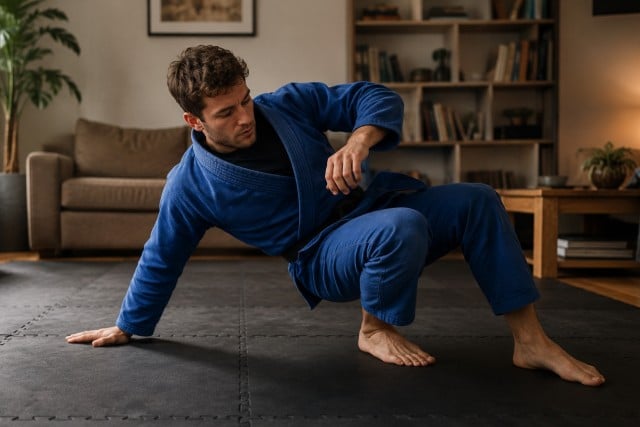
3. Technical stand-up
This drill builds the habit of getting up without giving away balance. Even if you are not using it constantly in rolling, it improves base, posture, and the connection between your hands, hips, and feet.
- Focus on: posting one hand, keeping one leg ready as a shield, and standing without crossing your feet.
- Carryover: safe stand-ups, wrestling-up sequences, and general athletic movement.
- Common mistake: jumping straight upward instead of creating structure first.
4. Granby-style shoulder roll
You do not need an advanced inversion game to benefit from shoulder rolls. At a beginner level, this drill helps you get comfortable rotating over a shoulder, protecting your neck, and moving your hips through space.
- Focus on: rolling on the shoulder line, tucking the chin, and keeping the movement smooth.
- Carryover: scrambles, guard retention, and confidence during awkward transitions.
- Common mistake: rolling over the neck instead of the shoulder.
5. Sit-out
The sit-out is one of the best solo movements for connecting BJJ with wrestling mechanics. It teaches hip clearance and turning the corner, both of which matter in front headlock exchanges and top-position movement.
- Focus on: posting strongly, kicking one leg through, and turning your hips fast without losing base.
- Carryover: turtle movement, front headlock escapes, and top pressure adjustments.
- Common mistake: making the motion too big and slow.
6. Bridge and shoulder walk
A bridge on its own is useful, but beginners get more from learning to bridge and then move. Add small shoulder walks so the drill resembles how you create angle before an escape.
- Focus on: driving from the feet, lifting the hips, and turning onto a shoulder instead of bridging straight up with no direction.
- Carryover: mount escapes, side control escapes, and pressure relief.
- Common mistake: bridging with the lower back instead of driving through the whole body.
7. Supine guard retention hip switch
Lie on your back, bring your knees toward your chest, and switch side to side as if you are following a passer with your shins and hips. This is a simple way to build movement that links directly to retention.
- Focus on: active feet, quick hip turns, and recovering square alignment.
- Carryover: staying in front of a passer and reconnecting your legs.
- Common mistake: waving the legs around without moving the hips underneath them.
How to make solo drilling actually work
Pick three drills per session and do them for short, focused rounds. For most beginners, 10 to 15 minutes is enough. A simple format is 40 seconds of work, 20 seconds of rest, for 2 to 3 rounds per drill.
Quality matters more than volume. The article How Your Brain Learns BJJ makes the same point from a motor-learning angle: clean reps and clear attention beat mindless repetition.
If you want to pair your solo movement with study, use one short instructional clip and one specific goal. Do not watch an hour of technique and then try to remember all of it. These free BJJ instructional resources for beginners are a practical place to find movement ideas without overcomplicating things.
A simple weekly solo BJJ routine for beginners
Here is a realistic starting point:
- Day 1: hip escape, reverse shrimp, bridge and shoulder walk
- Day 2: technical stand-up, sit-out, supine hip switch
- Day 3: granby-style shoulder roll, hip escape, technical stand-up
That is enough to build consistency without turning solo work into its own separate hobby. If you want to organize your drilling and video study into a bigger system, this guide on building a complete BJJ game with online instructionals gives a useful structure.
Common mistakes beginners should avoid
- Doing solo drills too fast and calling it conditioning instead of movement practice.
- Picking flashy inversion drills before basic hip movement is solid.
- Training for too long and losing precision.
- Never connecting the drill to a real position from sparring.
- Using solo work as a substitute for class instead of a support tool.
Final thoughts
The best solo BJJ drills are not the most impressive ones. They are the ones that help you move better when a real exchange starts to get messy. For beginners, that usually means better hips, better posture, better shoulder movement, and better coordination when changing direction.
Start simple, stay consistent, and tie each drill back to a real problem from training. If a solo movement helps you escape pressure, recover guard, or stand up with balance, it is doing its job.