What It Takes to Earn a BJJ Black Belt
In Brazilian Jiu-Jitsu (BJJ), the black belt is more than just a symbol of technical mastery—it’s a reflection of years of discipline, struggle, humility, and evolution. Unlike other martial arts where black belts may be awarded in a few short years, earning one in BJJ is a long-term journey that requires deep personal transformation.
This article breaks down what the BJJ black belt means, how long it takes to achieve, and the expectations that come with it.
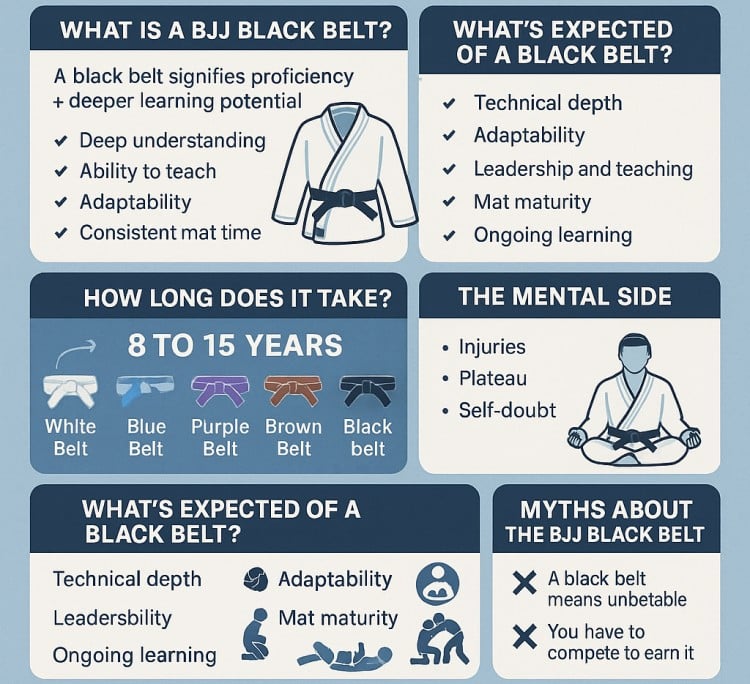
What Is a BJJ Black Belt?
The black belt in BJJ signifies a high level of proficiency in both technique and application. But it’s not just about submissions and sweeps. A black belt should also demonstrate:
- Deep conceptual understanding
- Ability to teach and lead
- Adaptability across gi and no-gi
- A track record of consistent mat time
Many BJJ black belts say that earning the belt is not the end—it’s the beginning of a deeper phase of learning.
How Long Does It Take?
On average, it takes 8–15 years to earn a black belt in Brazilian Jiu-Jitsu. The variation depends on factors like:
- Consistency of training (2–5+ times per week)
- Athletic background and learning curve
- Instructor expectations
- Competition performance (optional but influential)
BJJ doesn’t have formal testing for every promotion. Many instructors promote students based on skill, mat time, attitude, and maturity, not just performance in drills.
The Belt Journey: Overview
Here’s the typical adult belt progression:
- White Belt – The beginner stage (learning to survive)
- Blue Belt – Basic understanding of positions and escapes
- Purple Belt – Intermediate level, building personal style
- Brown Belt – High-level game refinement and teaching
- Black Belt – Mastery of both offense and defense, teaching ability, mat IQ
Each stage includes 4 degrees (stripes) marking progress.
Some academies also award coral belts (red/black) after decades at the black belt level, but this is extremely rare and often honorary or for major contributors to the sport.
What’s Expected of a Black Belt?
By the time you receive your black belt, your coach and community expect more than just skill:
1. Technical Depth
You should demonstrate control, precision, and variety in every position—whether you’re rolling with beginners or elite competitors.
2. Adaptability
You should handle various styles, body types, and rule sets (gi/no-gi, IBJJF, ADCC) with confidence.
3. Leadership and Teaching
Most black belts are also instructors, mentors, or role models in their academy. Being able to explain complex ideas simply is part of your skillset now.
4. Mat Maturity
You’re expected to roll safely with newer students, help build a positive culture, and always act with humility—even when dominating.
5. Ongoing Learning
Black belt isn’t the final stage—it’s just a new level of refinement. Many black belts say they begin to truly “understand” Jiu-Jitsu only after reaching black.
The Mental Side of the Black Belt Journey
You’ll go through injuries, plateaus, and self-doubt. You’ll question your abilities, especially when others advance faster. And you’ll discover that perseverance—not talent—is what earns belts in BJJ.
Most people who reach black belt didn’t out-talent others. They outlasted them.
Myths About the BJJ Black Belt
- “A black belt means you’re unbeatable.” – Not true. Even black belts lose, especially to other black belts or younger, more athletic opponents.
- “You have to compete to earn it.” – Competition helps, but many black belts never compete. Consistency, skill, and contribution matter just as much.
- “Once you get the black belt, you’ve ‘made it.’” – Many describe the black belt as a new beginning, not the end.
Final Thoughts
Earning a black belt in Brazilian Jiu-Jitsu is a marathon, not a sprint. It’s a symbol of a person who has endured, evolved, and dedicated themselves to a lifetime of learning on the mat. For those willing to put in the years, the black belt is a deeply meaningful accomplishment—one that’s less about what you get and more about who you become in the process.
As the saying goes, “A black belt is a white belt who never quit.”